InformationSuperb view fireworks of Mt. Fuji
The ZEKKEI Fireworks “Mt.Fuji” 2026 -KOKON MUSOU- Official Report
2026/08/11
Japan is one of the world’s leading fireworks nations. It is said that around 1,000 fireworks festivals are held across the country each year. July and August mark the peak season, accounting for roughly 70 to 80 percent of the total. At the same time, so-called autumn fireworks events, held from September through November, have been increasing as organizers seek to provide audiences with cooler weather while avoiding typhoon season. Winter fireworks, staged from December through March, have also taken root in places such as Odaiba, Lake Kawaguchiko, and mountain resorts, where visitors can enjoy fireworks against the backdrop of the crystal-clear beauty of the winter landscape.
Standing out among them is The Zekkei Fireworks @ Mt. Fuji, held every April and bringing together Japan’s renowned “Big 4” fireworks masters. This year, on April 25, The Zekkei Fireworks “Mt. Fuji” 2026 — KOKON MUSOU — was held at a special venue within Fujiten Resort in Yamanashi Prefecture.
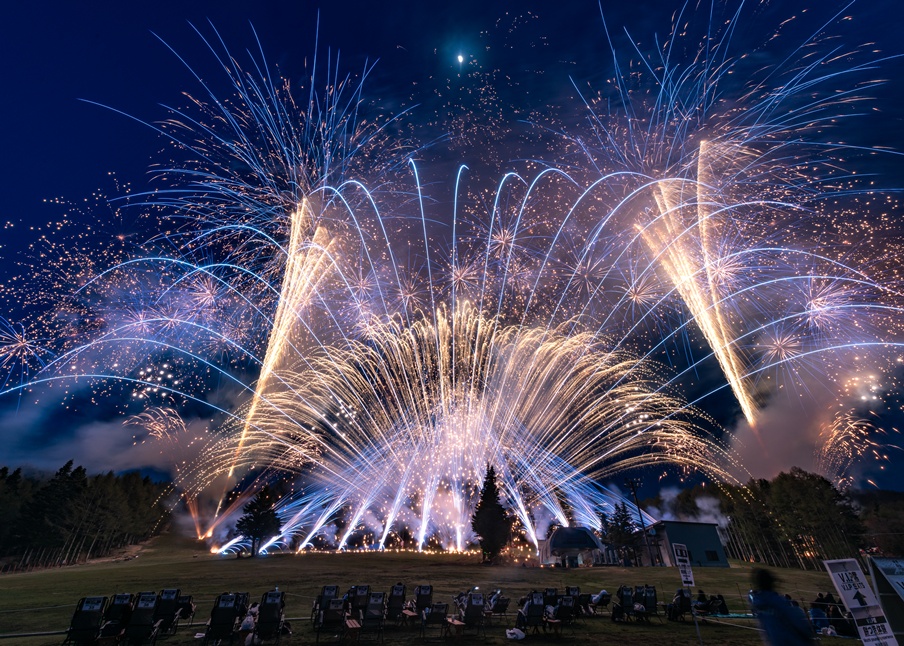
What makes Zekkei Fireworks so distinctive begins with its location and design philosophy. The stage, located on the first station of Mt. Fuji within the grounds of the World Heritage site, is truly one of a kind in the world. Although the venue can accommodate more than 10,000 people, the event deliberately limits capacity to only about 3,000 seats. With all seats paid and available by advance reservation only, it creates a luxurious viewing environment free from crowding and the scramble to claim a spot. In addition, because nothing obstructs the space between the launch site and the audience, spectators can experience not only the visual spectacle, but also the thunderous sound, the scent of gunpowder, and even the vibrations transmitted through the ground. This concept of a fully immersive, all-sensory fireworks experience is one of the event’s greatest strengths.
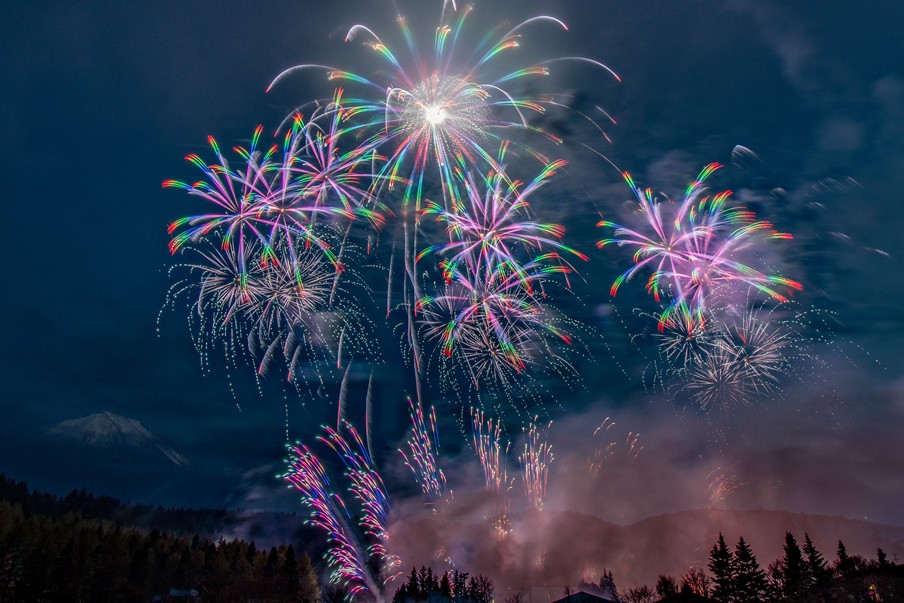
Another striking feature in recent years has been the growth in international demand. This year again, one-third of the audience came from overseas. The combination of snow still remaining on Mt. Fuji, cherry blossoms in the surrounding area, and world-class fireworks offers a richly condensed experience of “Japaneseness” that has been highly praised by international visitors. In the VVIP and VIP areas, guests are offered not only exclusive viewing spaces but also premium Japanese culinary experiences, including sushi. Ticket prices range from several tens of thousands of yen to well over two hundred thousand yen, yet these premium seats sold out one after another from the presale stage. The event’s true innovation lies in the fact that it has been completely redefined not as “just another local summer festival,” but as a luxurious cultural experience from Japan that can be proudly presented to the world.
This unique positioning is all the more remarkable given that many fireworks festivals across Japan are free to attend and designed for massive crowds, where securing a spot and navigating the throngs of people are considered part of the seasonal tradition. In contrast, Zekkei Fireworks has carved out its own place through the opposite approach: paid admission, limited attendance, and high added value. It also offers some of the closest viewing areas of any fireworks event in the country, where the fireworks seem to bloom almost directly overhead and pour down upon the audience in three dimensions. This extraordinary sense of immersion is something few other events can offer. The combination of luxurious spaciousness, free from congestion, and overwhelming proximity experienced through all five senses may seem contradictory, yet it is precisely this rare balance that has drawn increasing attention from both Japan and abroad with each successive edition.
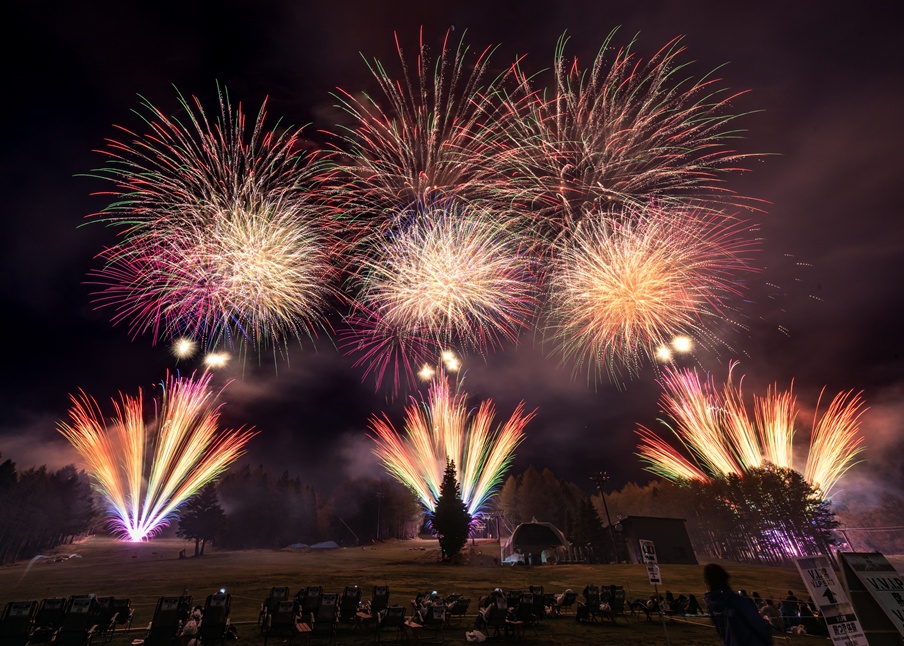
With the clear and one-of-a-kind concept of “the finest fireworks at one of Japan’s most spectacular scenic locations,” Zekkei Fireworks began in 2020 as a pilot event (with 2021 canceled), making this year its fifth edition. Japan’s representative “Big 4” fireworks companies—Beniya Aoki Fireworks, Isogai Fireworks, Saiki Fireworks, and Kikuya Obata Fireworks—were all present once again. This year, they were joined by a guest fireworks company possessing a level of technical mastery equal to that of the Big 4: Kitanihon Fireworks, a long-established company founded in 1899 in Omagari, Akita Prefecture, one of Japan’s most famous fireworks centers, and widely known as a pioneer of character fireworks.
On April 25, Mt. Fuji stood quietly with more snow than usual still remaining on its slopes, while late-blooming cherry blossoms colored the area around the venue. In the cold, crystal-clear air, the contours and colors of the fireworks appeared all the more vivid. Fireworks viewed in the clear night air at an elevation of approximately 1,200 meters shine with a brilliance entirely different from those seen on flat ground. Zekkei Fireworks reaches its first climax at dusk. Against the fantastical figure of Mt. Fuji, a prologue display titled “Fuji at Twilight” was launched. Fireworks bloomed over the mountain in a scene of elegance and beauty like a painting, prompting cheers from the audience.
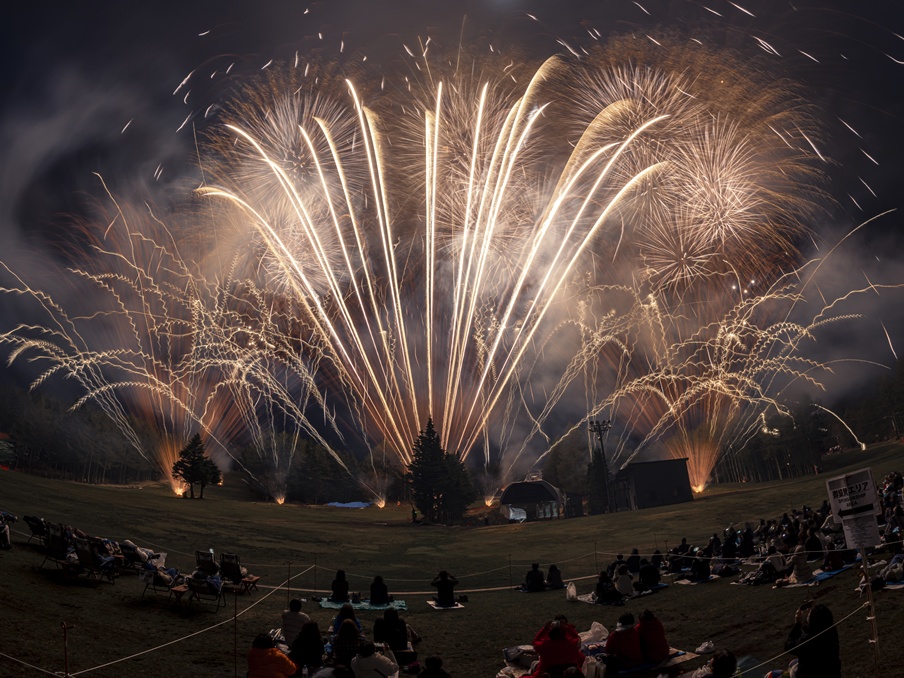
Another element rapidly becoming a new pillar of this event, tedutsu hanabi (hand-held fireworks), appeared as a special program. Said to have originated at Yoshida Shrine in Aichi and considered Japan’s oldest form of fireworks, tedutsu hanabi electrified the venue as the bearers stood bravely amid towering columns of flame showering over their entire bodies. From there, a succession of distinctive performances unfolded: a star mine by Beniya Aoki Fireworks that lit the darkening ridgelines of Mt. Fuji like starlight; a historic first collaboration between the great masters of shaped fireworks from east and west, Isogai Fireworks and Kitanihon Fireworks; monochrome fireworks by Kikuya Obata Fireworks that expressed the “ultimate wabi-sabi” without using any colored fire at all; and a production by Saiki Fireworks that cast a rainbow of seven colors across Mt. Fuji. The event’s greatest strength lies in being both a shared stage and a competitive arena for some of Japan’s most representative fireworks companies, each with well over a century of history, all of whom have helped elevate fireworks festivals throughout the country through mutual inspiration and friendly rivalry.
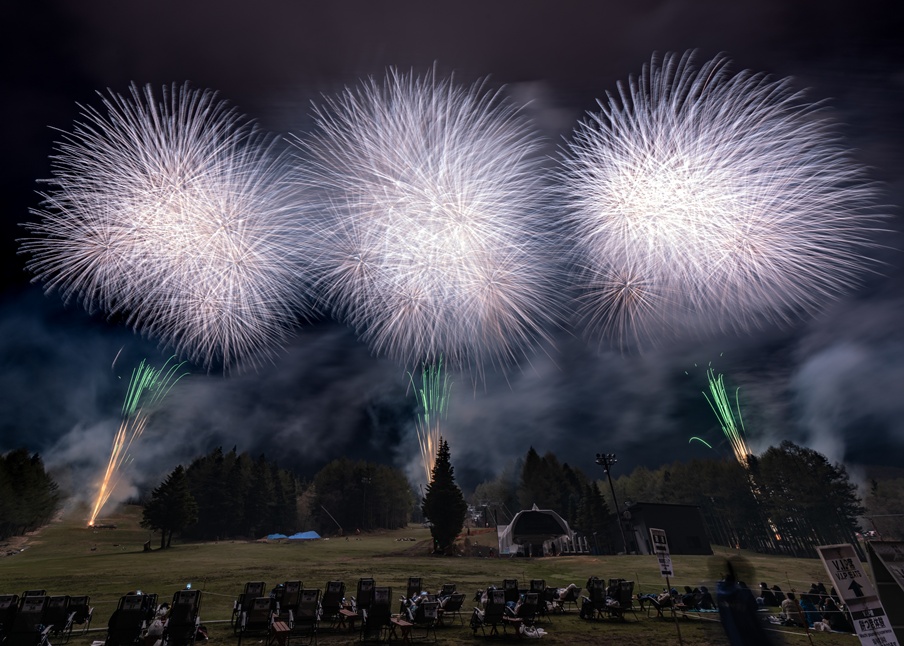
The finale was “Fugaku Yumekei” (Dreamscape of Fuji), in which all five companies united their skill and passion in a single star mine. Using Mt. Fuji’s vast foothills as a canvas, the display filled the night sky with a density, color, and earth-shaking roar that shattered all conventional expectations, drawing thunderous applause from the audience.
For Kitanihon Fireworks, participating for the first time brought home both the difficulty and the depth of staging fireworks in a ski resort environment, where the terrain and the distance to the audience dramatically affect how the fireworks are perceived. Even so, the company reflected that it took on the challenge with one guiding thought in mind: to create fireworks worthy of the divine majesty of Mt. Fuji, which seemed to float above the clouds.
The pride of fireworks masters who continue to evolve while honoring traditional techniques, the overwhelming natural beauty of Mt. Fuji, and the refined hospitality that places the comfort of the audience above all else—brought together in exquisite balance, these elements made The Zekkei Fireworks “Mt. Fuji” 2026 a true milestone in Japanese fireworks entertainment. The next edition has already been set for Saturday, April 17, 2027, at the same venue on an even larger scale. It is already exciting to imagine what kind of evolution the Big 5 will unveil at the foot of Mt. Fuji next spring.